


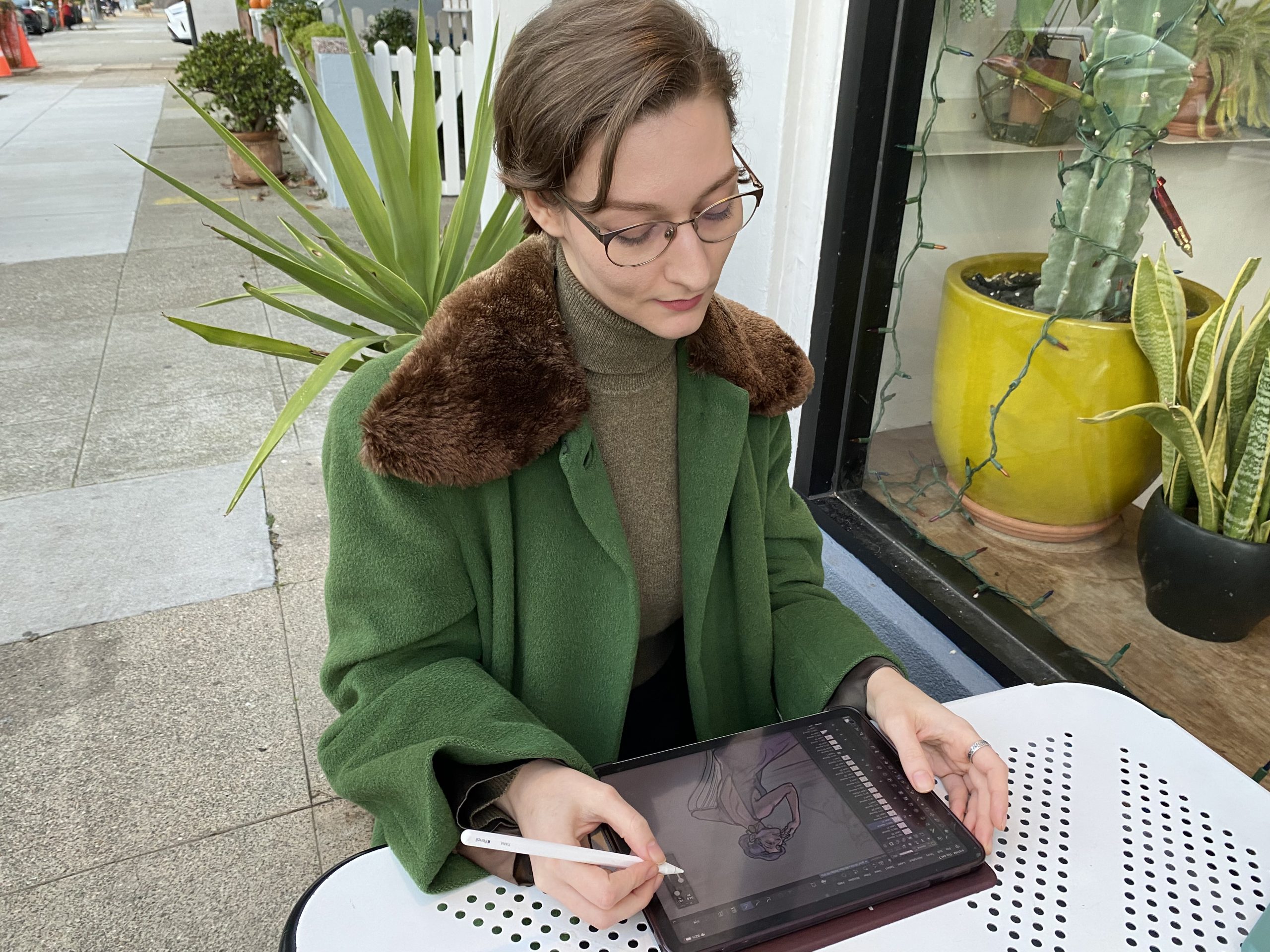
For the San Francisco Public Press–San Francisco artist Tiana Oreglia has been closely watching how transparency rules surrounding generative artificial intelligence unfold.
“There’s a lot of caginess about what’s in those datasets” built by generative AI companies, said Oreglia, 31, who works as a freelance concept artist for video game companies.
In the past, OpenAI and other AI companies have given vague answers on where they get the data they use to develop their systems that are called models. Oreglia said she wants to tell them, “Hey, my work is actually there, and I don’t want it to be there.”
When prompted, generative AI uses training data — such as images, text, video and audio — which it learns from to identify patterns and trends, and then recombines to generate new text, images, video and audio. Many creative professionals — including visual artists, writers, actors, singers and musicians — are concerned that companies are feeding existing creative work into data troves and applying generative AI to produce content based on their original work without giving credit or compensation. Creative professionals say their work is being used and monetized without their permission.
Oreglia is a member of Concept Art Association, a Los Angeles-based nonprofit advocacy organization representing artists who create the concept for the visual elements for movies, video games and animation. The group supported California’s generative AI dataset disclosure law, which Gov. Gavin Newsom signed into law last fall and which went into effect Jan. 1. Generative AI companies must comply with the law by Jan. 1, 2026.
The legislation mandating generative AI companies to acknowledge copyrighted material in training data is “solid concrete action” to bring some transparency to “an unscrupulous, opaque and predatory model for data acquisition,” the Concept Art Association stated in support of the disclosure law.
Nicole Hendrix, co-founder of the association, said a lot of creatives “feel violated — because you basically had your portfolio stolen and then used against you and replacing you” with generative AI.
According to think tank CVL Economics, by 2026, generative AI could negatively affect 62,000 of California’s entertainment jobs — some would be consolidated, some would be replaced and some would be eliminated. The association’s leaders say strong legislation can protect the livelihood of creative workers.
Read full story here.